Utstilling

Avgang 2026: Gloriya Talebi / Close, but No Cigar
Close, but No Cigar is Gloriya Talebi's individual MFA graduation project.
The jewellery shop I walk into is not only a jewellery shop. It sells makeup, keychains, belts, phone accessories, children's toys, stickers, home decor, perfume and more.
On a rotating stand hang sheets of eyeliner tattoos and plastic prayer beads. On the floor beneath it lie two old sticker sheets, one with Finding Nemo, the other with glittery fruit. They are slightly dusty, as if no one has touched them for a long time.
Along one wall, belts with Che Guevara's face are hanging next to an Iraqi and Syrian flag. Metal keychains that say Free Palestine lie beside Hello Kitty plushies. Beneath the jewellery displays, gift boxes are stacked in small piles. Some are cracked at the corners. Some have lids that do not quite fit.
Still, they are for sale.
I bring the two sticker sheets and a Palestine keychain to the counter and pay. The man at the counter places them in a plastic bag that is printed with teddy bears and the words "Miss you" across it.
As I am about to leave, he calls me back.
Do you like perfume?
Of course I like perfume.
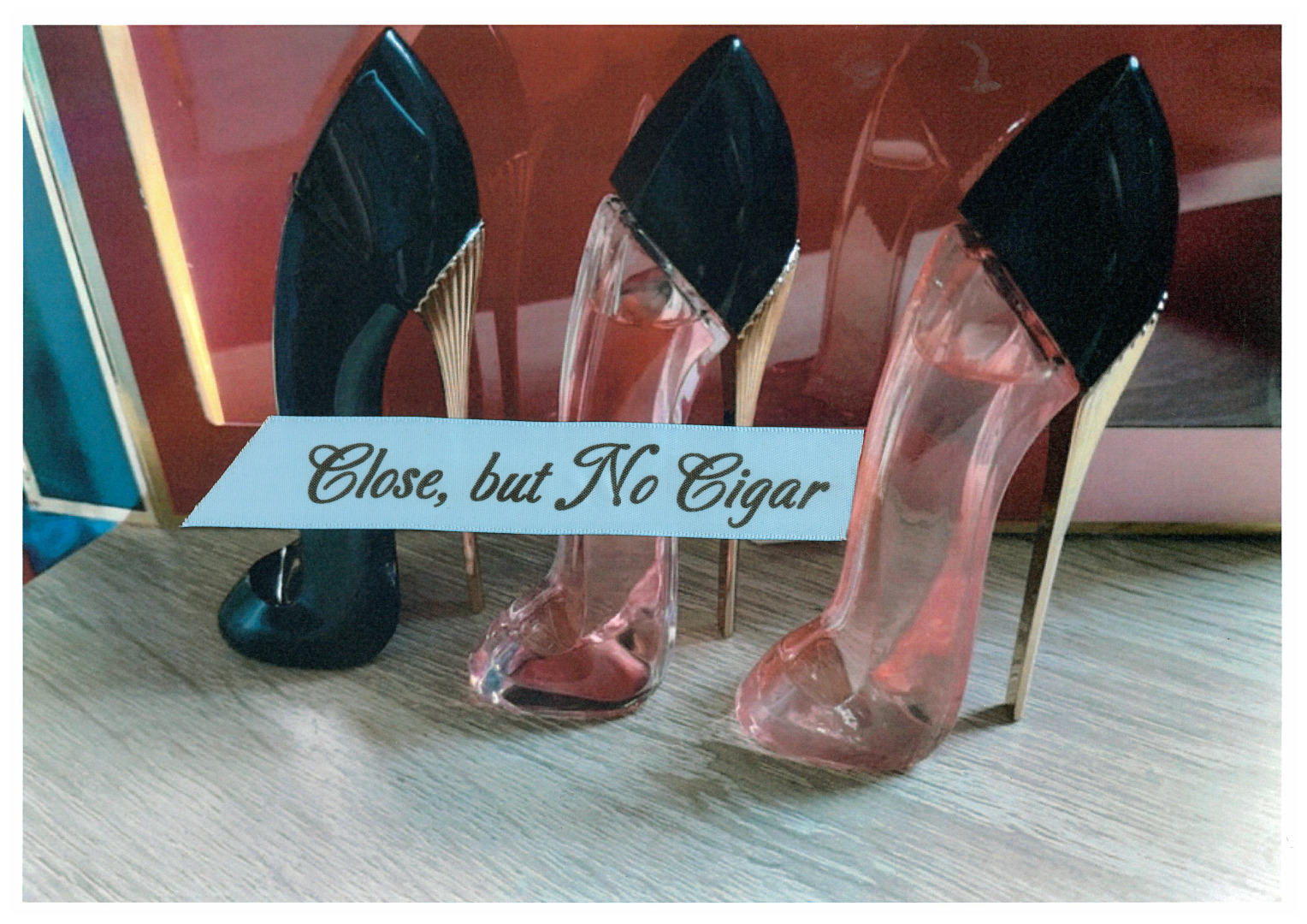
He asks if I like Good Girl by Carolina Herrera. I tell him I have never smelled it. He takes out a large pump and sprays directly onto me several times. The sound is sharp. The scent settles into my jacket, my hair, my skin.
He asks if I like Good Girl by Carolina Herrera. I tell him I have never smelled it. He takes out a large pump and sprays directly onto me several times. The sound is sharp. The scent settles into my jacket, my hair, my skin.
Close, but No Cigar is the first solo exhibition by Gloriya Talebi. The title comes from an old American phrase used when someone almost wins but does not quite get there. In this exhibition, it speaks to working with copies rather than originals, and to her ongoing engagement with fragments rather than complete images.
The works grow out of her close attention to neighbourhoods shaped by migration, such as Grønland in Oslo and Rosengård in Malmö (Talebi’s hometown), and similar environments found in many cities. In small neighbourhood shops, unrelated objects often share the same space. Western branding and luxury imagery appear next to Middle Eastern ornament, religious references, furniture, and cookware. The visual language Talebi brings forward is shaped by movement between places rather than by a single culture, and often continues into domestic spaces, where interiors are built from what has been brought along, found, and kept.
Two women are standing nearby. He says something to them in Arabic and invites them to smell it too. They come closer. We stand close together and inhale the cloud of Good Girl.
It is too sweet for me.
Then he asks if I like Lost Cherry by Tom Ford.
Yes, I say.
This time he sprays into the air. He begins to show me the bottles behind the counter, while explaining sizes and prices. Suddenly, leaving the shop without a bottle of Lost Cherry becomes unthinkable so I choose a 30 ml bottle. He fills the small green glass bottle, adds one final spray to my wrist, closes it with a gold cap, and packs it into a new plastic bag. This time, a patterned one, decorated with black bows and red high heels.
On my way out, I hear him ask the two women if they’ve ever smelled Lady Million by Paco Rabanne.
Close, but No Cigar
Gloriya Talebi
14.02 – 28.02. 2026
Salgshallen (Storgata 36a)
Opening 14.02. 16:00 – 18:00
Opening hours:
Thursday 12:00–18:00
Friday–Saturday 12:00–16:00 Or by appointment
https://artacademycalendar.khio.no/mfa-graduation-projects/gloriya-talebi-close-but-no-cigar